BreathIn: Gamifying Smoking Cessation
BreathIn is a conceptual "serious game" that supports smoking cessation by turning behavioral therapy principles into game mechanics, giving patients an accessible, low-cost tool to get through cravings and withdrawal. The research and design study behind it was published in two peer-reviewed papers.
The Problem
Smoking remains the top cause of preventable diseases globally. While 80% of smokers want to quit, only 4% succeed without assistance, and many avoid professional help due to cost or stigma. When acute cravings hit, patients lack immediate, engaging interventions to prevent relapse.
The Solution & Product Vision
To bridge this gap, I designed the foundation for a mobile serious game that distracts users through withdrawal. The concept combines:
- Real-time health tracking: the body's recovery timeline after quitting is mapped onto the in-game avatar's health to keep motivation visible.
- Cognitive distraction: jumping mechanics and informational puzzles occupy users through the moments when cravings hit.
- Psychoeducation: behavioral therapy principles, personal milestones, and self-awareness prompts built into the gameplay loop.
UX Research & Design Process
To ensure the game mechanics were medically and psychologically sound, I led an end-to-end, user-centered design process:
- Generative research: online surveys and in-depth interviews with active smokers and people trying to quit, covering habits, motivations, and app usage.
- Requirement mapping: translated findings and addiction literature into concrete game mechanics and psychological strategies.
- Prototyping: a high-fidelity interactive Figma mockup covering core gameplay, tutorial flow, and progress tracking.
- Evaluative validation: testing rounds including a review with an expert in psychology and addiction medicine, followed by A/B testing with end-users to refine the UI and finalize the concept.
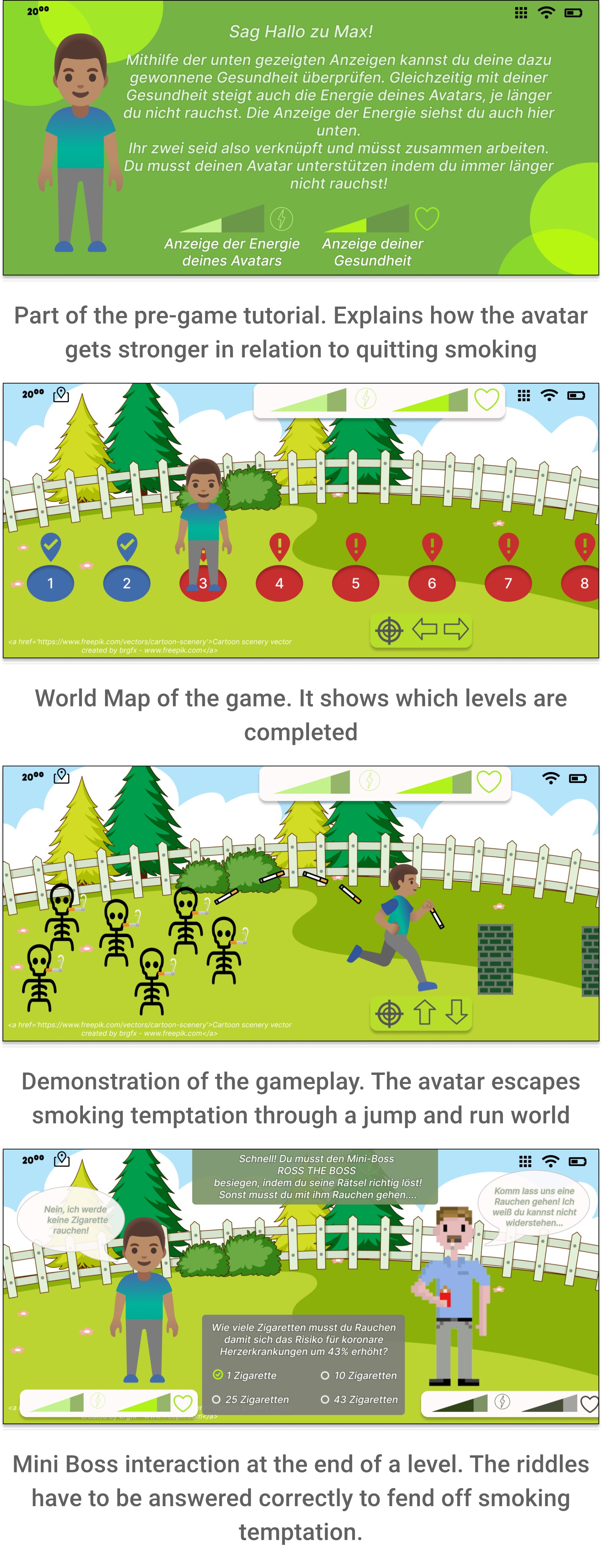
Core screens from the BreathIn Figma prototype: craving check-in, mini-game, and progress tracking.
Impact & Academic Validation
The UX research, conceptual design, and subsequent play-testing were academically validated and published across two peer-reviewed papers:
- 'BreathIn – A Serious Game to Support Patients with Smoking Cessation: Analysis and design study for a mobile serious game to help patients quit smoking'.
Aigner, C., Zeillinger, V., Baur, K., Baranyi, R., Grechenig, T. (2023). BreathIn – A Serious Game to Support Patients with Smoking Cessation: Analysis and design study for a mobile serious game to help patients quit smoking. ICMHI '23. Association for Computing Machinery, NY, USA, 239–244. https://doi.org/10.1145/3608298.3608342
- 'Analysis, Implementation, and Assessment of a Serious Game for Smoking Cessation: Investigating Design and Playtesting Outcomes'.
Aigner, C., Baranyi, R., Hoelbling, D., Baur, K., Zeillinger, V., Grechenig, T. (2024). Analysis, Implementation, and Assessment of a Serious Game for Smoking Cessation: Investigating Design and Playtesting Outcomes. EHB 2023. IFMBE Proceedings, vol 109. Springer, Cham.
What I Learned
- Learning #1
Health awareness needs support
Wanting to quit isn’t enough on its own. Making the body’s recovery visible and building self-awareness into the experience keeps motivation tangible.
- Learning #2
Explainability builds trust
Users trust a tool or an idea when they understand why it works. Explaining the reasoning behind each mechanic matters as much as the mechanic itself.
- Learning #3
Health concepts need expert validation
Whenever a design touches health, it should be reviewed by professionals too, like the review with an expert in psychology and addiction medicine in this project.
© 2026 Victoria Zeillinger · Impressum